FULL-PROOF Launches First Animation on the Right to Information
Understanding rights at the very start of criminal proceedings can be difficult for suspects and accused persons, especially in stressful and unfamiliar circumstances. With its first animation, FULL-PROOF draws attention to the importance of making procedural rights genuinely understandable and effective in practice.
The new material focuses on the right to information, a fundamental safeguard in criminal proceedings. Its purpose is not only to ensure that people are formally informed of their rights, but also that they are able to grasp what those rights mean and how they can be exercised.
Click below to watch the animation:
Through this animation, FULL-PROOF underlines a core issue addressed by the project: providing information is not enough if it is delivered in a way that is unclear, inaccessible or unsuited to the individual situation of the person concerned. Effective communication is essential to ensuring that procedural safeguards are respected in real-life proceedings.
FULL-PROOF is a project co-funded by the European Union that supports stronger respect for the procedural rights of suspects and accused persons during the early stages of criminal proceedings. Its work responds to a continuing gap between legal standards set out in EU legislation and their practical implementation across Member States.
As João Gomes, FULL-PROOF Coordinator at IPS Innovative Prison Systems, points out, poor communication of rights at the beginning of proceedings may weaken the defence, influence the overall fairness of the process and reduce public confidence in justice institutions.
The animation is the first of several awareness-raising materials that will be published in the coming months as part of the project’s wider communication activities.
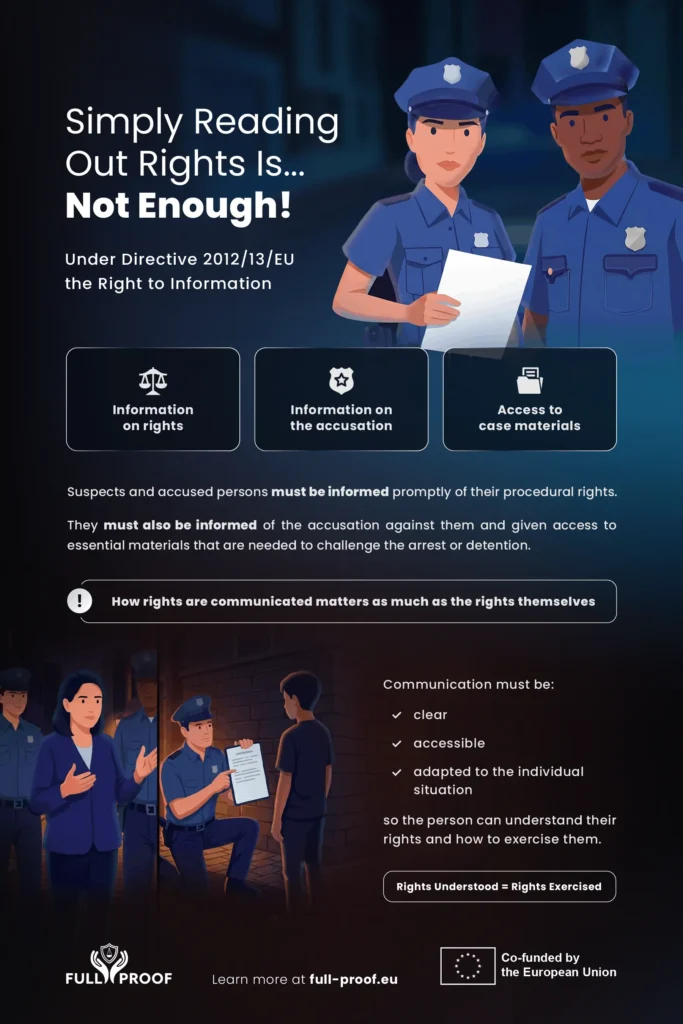
Infographic: Key Takeaways from the Animation
Explore the infographic below to discover the key messages from the animation on the right to information in criminal proceedings.
Available in different languages
Both the video and infographic are available in Bulgarian, English, Italian, Polish, Portuguese, Romanian, Slovak and Slovenian.
Choose your preferred language and see the materials.
Bulgarian
Italian
Polish
Portuguese
Romanian
Slovak
Slovenian
| Bulgarian Download the infographic | Italian Download the infographic |
| Polish Download the infographic | Portuguese Download the infographic |
| Romanian Download the infographic | Slovak Download the infographic |
| Slovenian Download the infographic |